Thursday, February 25, 2021

The Utopia of Utah

In many cultures, societies, and religions, there is some myth or memory of a distant past when humankind lived in a primitive and simple state but at the same time one of perfect happiness and fulfillment. In those days, the various myths tell us, there was an instinctive harmony between humanity and nature. People's needs were few and their desires limited. Both were easily satisfied by the abundance provided by nature. Accordingly, there were no motives whatsoever for war or oppression. Humans were simple and pious.

These mythical or religious archetypes are inscribed in many cultures and resurge with special vitality when people are in difficult or critical times. However, in utopias, the projection of the myth does not only take place looking towards the past, but also towards future times or distant places, imagining that there must exist the possibility of living even better, even happier--of being more inspired--this is what America is all about.


Our trip through the Canyonlands of Utah this Fall provided such inspiration--whether it be the peace and solitude of remote lands, the rugged drama of monumental landscapes, the extraordinary history and pioneer spirit of those who wandered before us, or just the search for calm and tranquility within a turbo-charged society--social distancing does have its merits.
 
As the maples on our Far North Idaho property hinted it was time to hit the trail...

...we headed southeast across the state to Bear Lake on the Idaho/Utah border.  Now whenever you hear about a body of water being called "The Caribbean of this or that" (as Bear Lake is cited in Idaho) you should temper your expectations--so imagine our shock and awe as we visited this area for the first time--a sight to behold!  

It's not that we don't have LOTS of spectacular places in Idaho (shhh, don't let any more of those Californians know!), but the lake was stunningly gorgeous--deep blue and crystal clear--and it was basically devoid of tourists. 


Of course we were there at the start of the off-season, but the limited development in the area (commercial and residential) would seem to indicate that its somewhat "isolated" location keeps it pristine and quiet most of the year.  The "local" population is primarily Mormon and there are many small family farming operations directly across the two-lane road encircling the entire lake's shores. Thankfully it appears that most of those farms are still closely-held and developers have not infiltrated the area...yet. Although we did not camp along the lake (just made a day trip), there were several state-run and Bureau of Land Management campgrounds right on the sandy beach shores. We will definitely plan a future southward winter route to include a return visit!


We then took several minor highways to wind our way from Bear Lake to Torrey, Utah--absolutely incredible fall scenery and many times we were the only traffic on the road, in both directions!!!  Not sure if the Canadian border closure (i.e., no southern snowbird "flights" from Canada) accounted for the barren roads, but we had no complaints!!  


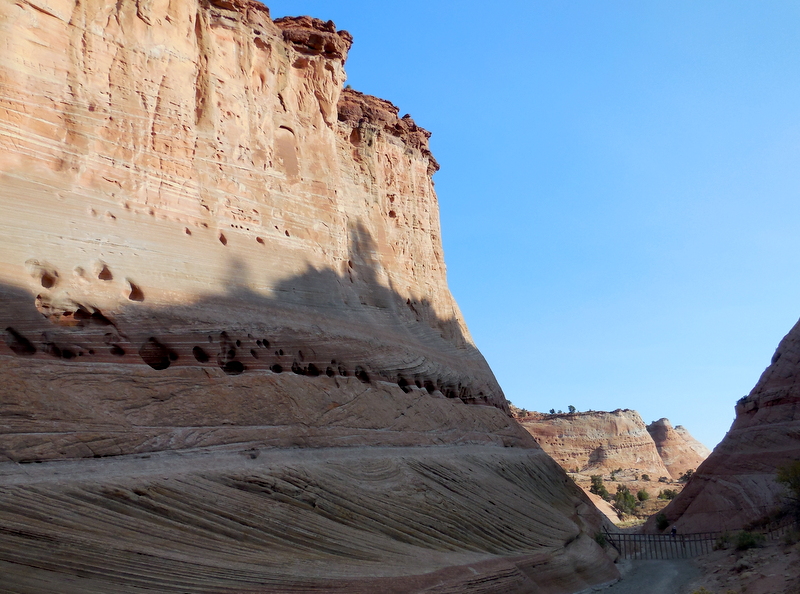
We camped on public land in Torrey, outside of Capitol Reef National Park--one of the few fee-free parks in the federal system.  In the heart of Utah's red rock country, The Park surrounds a 100-mile long buckle in the Earth's crust known as the Waterpocket Fold--dubbed as a reef, because it blocked early explorers' passage like a reef blocks a ship's passage.  It is also known for its enormous Navajo sandstone domes, one of which resembles the US Capitol in Washington, DC. 


The weather was spectacular--unusually warm, even at 6,500 ft elevation--and the slot canyon hiking and "reef" sightseeing was even better than we imagined!!!  Although the weather did contribute to probably more park visitors than usual at this time of year, we were left to discover our own "private" park sites and hikes for over two weeks!! 

Note the "Welcome" sign and natural vista reminiscent of Edward Abbey's days


White sandstone pillars of "Capitol Reef"


Hoodoos of Capitol Reef NP

Hickman Natural Bridge


Pre-National Park, it's no wonder that Native Fremont Indians called this vast landscape of tilted buttes, jumbled rocks and winding canyons the "Land of the Sleeping Rainbows".


Aside from the widely-varied rock and canyon formations all carved by water, a very unique aspect of Capitol Reef National Park is the "town" that lies in the heart of the Park--the Fruta Historic District--a cool green oasis where mature, shade-giving cottonwoods and fruit-bearing trees line the banks of the Fremont River. Providing fruit and nuts for subsistence, trade, and sale, the first Mormon homesteaders arrived in 1880 and Fruta's final resident left in 1969. The National Park Service now maintains the 2,700 cherry, apricot, peach, pear and apple trees planted by early settlers, and if you visit between June and October, you can eat ripe fruit straight from the trees for free!

 Overlooking the orchards of Fruta Historic District from Chimney Rock Trail
                                                                             

A funny side observation during our visit here, being outdoors, most visitors/hikers were sans masks (us included), but every once and a while we encountered the "glares" of masked marauders who couldn't pass by us fast enough!  Hilariously, they would grab their masks from around their necks and pull them up over their mouths as if perhaps we might aim and perfectly fire a spitball at them as they passed.  We quickly noted that nearly all those folks were aged 20-30 and they were from California, Colorado, or Oregon...we tracked the license plates in the parking lots ðŸ˜Ž


After Torrey we headed south to Escalante, Utah (through Flaming Gorge) to take in the immensity and beauty of Grand Staircase Escalante National Monument (GSENM).  Established in 1996 as the Bureau of Land Management's first national monument, GSENM doesn't really have an "entrance" but is a compilation of three distinct topographies comprising 1.9M acres of protected land: the Grand Staircase, the Kaiparowits Plateau, and the canyons of the Escalante River. What these three areas share are great distances, expansive vistas, primitive and difficult terrain, and a remoteness rarely equaled in the lower 48 states; they also hold a special place in the soul of pioneers, explorers and Native Americans. This was evident even at our camping spot on public land off of the Hole-in-the-Rock Road--made famous by the Mormon pioneers.


GSENM encompasses challenge, untrammeled beauty, and the frontier spirit and we were aptly  rewarded with stunning hikes through magnificent river washes, multicolored plateaus and terraces, as well as intrepid slot canyons during our visit. 


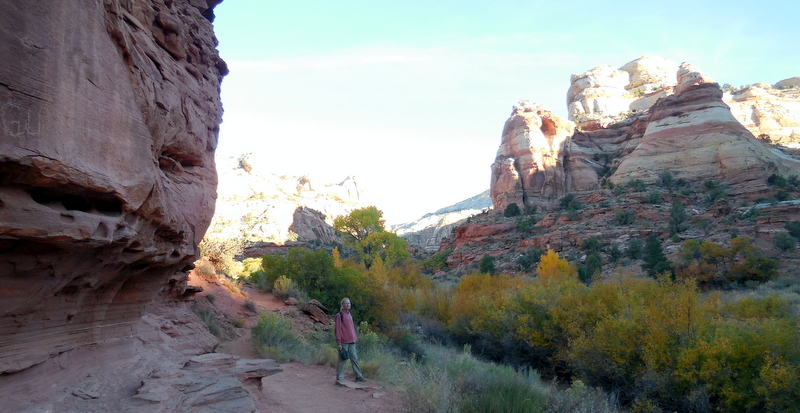
One of our favorite hikes by far (i.e., if you visit here, you MUST take this hike!) was to Lower Calf Creek Falls, a moderate 6-mile roundtrip hike worth every footstep!!

Just another hike in the Utah Canyonlands Desert...

...but note the cottonwoods at the foot of those spires...


...and the Ancient Puebloan granaries for storing corn, grain, and other foods harvested nearby...

...and the abundant trout in Calf Creek's natural "ponds"...


This is NOT just another Utah desert hike...Look Up!!


Named for its use as a natural pen for calves in the late 1800's, Calf Creek was relatively unknown until the formation of GSENM.  Walking between mineral-streaked cliffs of Navajo Sandstone, we passed beaver ponds. trout pools, and pre-historic rock art sites ending at this perennial 126-foot cascading waterfall and its paradisaical pools--truly a verdant desert oasis!


One of the most notable "historical" attraction of GSENM, is the 57-mile long Hole-in-the-Rock Scenic Backway--a gravel and dirt road that closely follows the wagon route taken by Mormon pioneers in 1879-80 in an attempt to establish a shortcut across the Colorado River between established communities in the center of the state and the Four Corners area.  The road was so wash-boarded that we didn't make it all the way to the Hole in the Rock on the Colorado River, but we did take enjoy hikes right off the road that gave us sense of what the Mormon pioneers would have encountered on their adventure. 


The Mormon pioneers spent nearly two months on their journey to the Colorado River.  Dance and music were an important part of their society and the excellent acoustics of the natural sandstone amphitheaters they found along the way, provided perfect locations to stop and enjoy relaxing entertainment breaks in their otherwise arduous journey. These amphitheaters became known as "Dance Hall Rocks" and were welcome respites for the weary pioneers.


We chuckled at our concern over the teeth-rattling drive when we learned the history of the great Mormon expedition--
On January 26, 1880, after six months of blasting and chiseling, an expedition of 250 Mormon Pioneers with their wagons and livestock descended through a rocky crevice known as the Hole in the Rock to the Colorado River below (now Lake Powell).  The 1,300 foot descent approaching 45 degrees could only be accomplished after widening the upper section with blasting powder, chiseling off high points in the dugway, creating anchor points directly into the sandstone for large ropes to hold back the wagons, and with pick and shovel building up a road bed at key points.While the Hole in the Rock was a major obstacle, the overall journey from Escalante to Bluff, Utah was nearly 200 miles of the most forbidding area to travel.  
___________________________________________________________________________

As if to make a point, though, we encountered some "pioneer" experiences with our RV at this point in our travels.  Given that GSENM is comprised of nearly 2M acres of protected land, cities and towns are few and far between and those that are nearby are not bustling with commercial activity so resources are limited.  First, we had a water valve break in our basement. Fortunately, the water pump was off so the resulting basement "flood" was not so bad, but without a valve replacement, we were unable to use any faucets in our RV.  Water was free and plentiful at the national monument headquarters so we just filled any and all available water carriers to use in the RV and heated water in pots for washing and showers.  

But then one day we noticed that we no longer had AC power in our RV--the DC power from the solar was working fine, but the inverter was not producing AC power for the electrical outlets.  Again, not a big deal, but we had limited comfort in not being able to charge our computers or MiFi for communication purposes.  Usually when we're on the road we visit local coffee shops, etc., to get on our computers and keep them charged, but during this age of Covid, the businesses that we would rely on for this service were either closed or open for take-out only...and electricity wasn't on the take-out menus!  

We thought about shortening our visit to the area, but the weather continued to be so amazing and the hiking and sightseeing so exceptional, that we decided to "pioneer" it.  Okay, I suppose running the truck engine to charge our computers/MiFi isn't really "roughing" it, but without running water and electricity in our RV, we did kind of feel like we were telepathing those Mormon pioneers ðŸ˜°
____________________________________________________________________________

After Escalante, we drove directly "through" Bryce Canyon National Park, and honestly, we didn't even feel like we missed out by not paying the $50(!) entrance fee.  The iconic crimson-colored hoodoos were EVERYWHERE!!  In fact, some of the best photos I took were from the truck window as we wound our way through the spire-constrained single-lane highway...with rig in tow!!  Talk about adventure!!


And that brings you up-to-date!  We are presently in Quartzsite, Arizona, complete with running water and electricity.  Quartzsite is the recreational vehicle mecca of the US, especially in the winter.  There is nothing you can't find for your RV (and for a GREAT price too!) and no one who doesn't know how to fix or install anything and everything for your RV.  The valve replacement was easy (and we now have several extra!) and the inverter issue was easily rectified by replacing a fuse in the basement that had gotten wet and blown...when the water valve broke ðŸ˜¡

We have been VERY fortunate to have not been constrained by Covid Rules...and have been happily "socially-distanced" for the past three months on public land in Kovid-free KOFA National Wildlife Refuge.


"A map of the world that does not include Utopia is not worth even glancing at, for it leaves out the one country at which Humanity is always landing. And when Humanity lands there, it looks out, and, seeing a better country, sets sail. Progress is the realisation of Utopias." —Oscar Wilde


Wednesday, November 11, 2020

Tails from the Backseat: Forever Young

Today is Jake's birthday--14 years old--and still forever young at heart--

 Happy Birthday Best Buddy!!

Don't you know that it's worth            And if you should survive to a hundred and five
Every treasure on earth to be             Look at all you'll derive from bein' alive
         young at heart                          And here is the best part, you have a head start
For as rich as you are                         If you are among the very young at heart
It's much better by far to be                                                        --Frank Sinatra
         young at heart                                                    


 May your hands always be busy,
May your feet always be swift,
May you have a strong foundation
When the winds of changes shift,
May your heart always be joyful,
May your song always be sung,
May you stay forever young,
Forever young, forever young
May you stay forever young.
                                             --Bob Dylan

Wednesday, August 26, 2020

Is it safe to travel again?

We've been in crime-free, covid-free, and politics-free North Idaho since we left the Mojave Desert in mid-March. The weather has been ideal for working in the forest (not as great for growing heirloom tomatoes) and everything necessary for living the good life is cheap and plentiful up here. Even so, the season is showing signs of change and the road is calling us again.

So why would we leave and begin another six months of life on the road? America has some big problems on its hands. Several generations of Americans have been raised to distrust or even hate large segments of the population as well as the institutions and traditions which used to somewhat bind our diverse citizenry together. This will not change regardless of what happens in November. Our nation isn't suffering from a flesh wound, it's stage IV cancer. Not impossible to treat, but not promising either.

Across the country there are groups looting and burning down businesses, banging on people’s vehicles while ordering drivers rudely where to drive, bearing down on people to intimidate them into expressing support for this or that cause, and committing other crimes of violence and property destruction.

These groups have tended to have the upper hand so far. Victims have been surprised and unprepared to be victims. Victims have thought police would protect them. Victims have figured the acts of violence and property destruction will soon fade away. 

Well, the fade away is not happening, and police have often failed to protect victims from harm. More and more, potential future victims are preparing for confrontation.

We are starting to see the victims fight back. This will not end well.

So how does a traveler in an RV deal with this. Simple. We'll be doing what we've always preferred to do anyway. Camping in the middle of nowhere in places like Wyoming, Utah, and the desert Southwest. We'll be safe wherever we are because we'll be in spots that are too difficult to reach and with too few juicy targets to attract "protesters". There will also be little or no police.

Will we feel safe? Sure, maybe not as safe as we are in Northern Idaho, but safe enough to not lose a second of sleep. Good planning can do that for you. Can you say the same about your situation?

Wednesday, March 11, 2020

Something Old and Something New

We spent most of our winter boondocking around the Superstition Mountains in AZ. This was a new spot for us mostly because we wanted to get some upgrades done to the 5th wheel and the location was convenient. We also found some new, interesting camping sites.

This isn't a bad spot to linger. It's close to Phoenix, so there are some snowbird crowds, but if you're willing to hit the trails no later than 8 am, you can pretty much have them to yourself.

One day we took an off the beaten path hike on the Old US Rt. 60. It was built in the 1920's by prison labor and was closed about 60 years ago when the modern Rt. 60 was opened.

Walking on the old Rt. 60 below a new Rt. 60 bridge near Superior, AZ

The old tunnels through the canyon were a lot narrower than the new tunnels built in the 1950's.


New tunnel on the right. The original road looks like a small path along the left side of the canyon wall.

It's amazing how fast they were able to build the original highway snaking through the canyon pass. Especially relying so heavily on manual labor. The bridge below is the same one from the first photo. The small trail from the water tank is the original highway.


There are miles of sections of the original Rt. 60 that are still around today. We did some scouting and found a nice campsite off of one section that was next to a large grassy area. It was almost as if this used to be a rest stop area of some kind back in the day.


It was a spot close to Phoenix, without neighbors, and with strange colored sunsets.

One of the many hikes in the Superstition Mountains is a popular one that climbs to a mountain saddle with a large cave called the Wave Cave. Our timing was good since we had the trail up all to ourselves... 

...and then we had the cave to ourselves as well.


On our way down we counted 75 people hiking up to the cave.  At least we were able to enjoy this spot in peace and quiet.

Arizona is a good place for RV upgrades or repairs. Here's a photo of our favorite upgrade this year. It's a Rhino Lining rock guard that works as good as it looks. It replaces the cheap textured paint that the factory installed as a "rock guard". If you're going off road and kicking up some debris, this really helps.

We're working our way back to Idaho and are camped in the Mojave National preserve. Our plan was just to pass through and spend a few days, but the place is fantastic. We'll probably stay here for about three and a half weeks. It may end up being our new favorite spot (more info. soon).