
Sunday, September 9, 2012

Thursday, July 26, 2012
Housing Market: Geronimo!
It's been a while since an economic post, and the data points we keep seeing are too tempting to pass up a comment now. At this point, it doesn't look like the US is in a recovery by any measure. What we are at the end of is a monstrous debt cycle that has been perpetrated over the last 40 years (yes, this is bi-partisan clusterf**k). It started with Nixon flushing Breton Woods down the toilet and closing the gold window. Every year/administration since, we have been consistently devaluing our currency and engaging in an orgy of massive borrowing in the private and public sectors.
This has many implications for all of us. The housing market is one that hits the hardest for most. Take it on fact, not faith, that the housing market is getting ready to go into collapse mode again and that the "tight inventory" argument being put forth by utterly biased frauds like the National Association of Realtors is total BS.
Traveling through the country, I take a great interest in real estate listings. The listings that are in short sale, foreclosure or just hundreds of days on market are growing. As an example, from a New Jersey newspaper: "The long-expected second wave of foreclosures in states where courts delayed their processing appears to have begun in New Jersey and area counties, with filings jumping in the second quarter from a year ago." LINK
Then this morning Bloomberg reported this: "Foreclosure filings rose in almost 60 percent of large U.S. cities in the first half of 2012, indicating many areas will have more distressed homes on the market later this year, RealtyTrac Inc. reported." LINK
THEN, the National Association of Realtors reported that pending sales for June dropped 1.4% unexpectedly in June. A .9% increase was forecast by Wall Street's Einsteins. Even more significant - and reinforcing a serial of downwardly revising previously reported data - the NAR downwardly revised the pending homes sales number for May. Here's a LINK. The disturbing reality is that this is the seasonal time of year that the housing market is supposed to be at its relative healthiest. In fact, the NAR data is seasonally adjusted - imagine how ugly the raw data must be.
The NAR's excuse for the drop in pending home sales is "tight inventory." But we know that's a bunch of BS. Short-sales are failing to close en masse. I personally know (and you may too) someone who was sitting in a house with a defaulted mortgage waiting for a short sale to close that failed because the financing fell through. Furthermore, a lot of the bank-owned inventory was shifted to Fannie Mae and Freddie Mac, who then off-loaded it onto investors in big blocks through a sale-to-rent program initiated by the Obama Administration. The rental inventory is going to balloon back up, including many apartment buildings that have been started and which have caused the building starts statistic to bounce over the past year. Rental prices for homes in many parts of the country have softened up from this past winter. I wonder why?
As the rental inventory expands and drives rents lower, it will also drive home values lower. This process will be exacerbated by this coming second wave of en masse foreclosures. I'm not the only one who perceives this insidious negative feedback cycle starting back up. For every area of the markets, I have certain analysts to whom I pay attention, mostly to confirm my own thinking or gain new insight. Mark Hanson is the guy worth paying attention to for housing market analysis. Here is a link to some of his analysis, and it's worth reading. LINK
If you are thinking about buying a house because your realtor is telling you that the market is tight and prices are going higher, don't do it. If you are thinking about selling your house to capture remaining equity value, get it done as soon as possible. This fall/winter could be very ugly, and not just for the housing market...
Friday, July 13, 2012
Living it up in the UP
We've been travelling through Michigan's Upper Peninsula for the last month, and it has been everything we were expecting and more. Being filled with National Forests, it's been easy to find secluded spots to camp for free off the grid. We spent 16 days in one spot near Munising, MI.

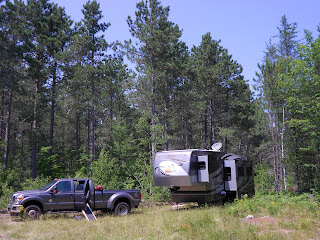 Sixteen days without any electric, water or sewer hookups is our current best. We should be able to easily push that up to 21 days someday when we find the right spot. Actually, it's hard to call this "camping". We have electricity (solar), satellite TV, a big refridgerator/freezer, bathroom/shower, and our own bed and sofa to come home to every night. This definitely isn't roughing it.
We do cook over an open fire most nights (much better than using the gas range or the convection oven). One night we cobbled together a meal of grass-fed organic sirloins purchased at a local farm we visited, some long grain wild rice hand harvested by native american indian tribes using traditional methods (available only in northern Minnesota and Wisconsin), and some fresh local greens from the Munising Farmers Market. To top it off, we opened a bottle of 2002 Keever Vineyards Cabernet Sauvignon (Yountville, Napa Valley). Definitely not roughing it.

This campsite in the Hiawatha National Forest was 10 minutes from Lake Superior in one direction and 10 minutes to dozens of inland lakes in the opposite direction. We were five miles from town, but had absolutely zero noise at night. Ours was the only camp fire or light for miles. We could walk the dogs anytime without needing to worry about running into other people or cars. It would have been nice
to be on a lake or stream, but if we were, it probably wouldn't have been as secluded (or as bug-free).
There are too many great photos to post them all. Here are some for now. I would say the hiking, lakes, streams, beaches, and scenery are as good as anything we saw in a month in New Zealand....and this place is a lot less crowded than NZ! If you're thinking of going to New Zealand for the outdoor activities of the South Island, save yourself some money and check out the area around Munising, MI first.

 A small piece of the Pictured Rocks. Those pictures deserve their own post later.


We do cook over an open fire most nights (much better than using the gas range or the convection oven). One night we cobbled together a meal of grass-fed organic sirloins purchased at a local farm we visited, some long grain wild rice hand harvested by native american indian tribes using traditional methods (available only in northern Minnesota and Wisconsin), and some fresh local greens from the Munising Farmers Market. To top it off, we opened a bottle of 2002 Keever Vineyards Cabernet Sauvignon (Yountville, Napa Valley). Definitely not roughing it.

This campsite in the Hiawatha National Forest was 10 minutes from Lake Superior in one direction and 10 minutes to dozens of inland lakes in the opposite direction. We were five miles from town, but had absolutely zero noise at night. Ours was the only camp fire or light for miles. We could walk the dogs anytime without needing to worry about running into other people or cars. It would have been nice
to be on a lake or stream, but if we were, it probably wouldn't have been as secluded (or as bug-free).
There are too many great photos to post them all. Here are some for now. I would say the hiking, lakes, streams, beaches, and scenery are as good as anything we saw in a month in New Zealand....and this place is a lot less crowded than NZ! If you're thinking of going to New Zealand for the outdoor activities of the South Island, save yourself some money and check out the area around Munising, MI first.

Typical sunset.


Just miles and miles of empty white sand beaches. You can drive to some of them or hike in for even wilder scenery.


Some of the 300 foot cliffs seen from the lake.

Another typical sunset. (they never get boring)
Tuesday, June 5, 2012
Tails from the Back Seat: Dam Good Fun
 Back in 1804 and 1806, when Lewis & Clark traveled the Missouri River, it was a winding shallow waterway. However , beginning in the 1940's the river was dammed to create four massive reservoirs, aka the Great Lakes Region of South Dakota. And why would this be of any interest to Karly and Jake? Because boon docking on Lake Oahe (one of the great lakes) in Pierre, South Dakota afforded them not only an opportunity for a first-in-their-lifetime adventure of romping through lake shore waves, but also to enjoy the experience being off-leash, as people were few and far between.
What good fun for Karly and Jake, what a muddy mess for Susan and John!!
But who could deny such joy?? Sometimes it's damn good to be a dog!!!!!!
 |
| Up to their "elbows" in mud |
Wednesday, May 23, 2012
How Awesome is This?
So far we have been able to find uncrowded off the grid places to camp for free that offer loads of hiking and even some fishing. All we need to do is provide our own water, food, electricity, and waste removal! Whether we are able to find these places after Memorial Day Weekend kicks off the travel season will be the big question.
Since we previously haven't been to any of the places we camp, it's always a little exciting and scary wondering what we'll find. When we rolled into the Soldier Creek Wilderness Area and the Nebraska National Forest in the far NW corner of Nebraska, our expectations were definitely exceeded.
We were all alone at the top of a bluff overlooking a pretty little valley with three creeks.

We did get some company when a couple showed up to do some exploring in the wilderness area with their four mules.

We had a dozen options for 10-12 mile hikes every day. You could hike all day and not see any signs of development. Not even a plane in the sky.

This area was very active in the last major war between the US and the Plains Indians in the 1870s. We were about 7 miles up a dirt road away from Fort Robinson. George Armstrong Custer spent some time here before heading north to meet his fate. Soldiers from Fort Robinson were also responsible for the massacre at Wounded Knee and the capture/death of Crazy Horse. There were a few old military wagon roads through the wilderness area.

We weren't next to the water, but 50 yards away from our rig was this little gem of a creek.

Hiking in all directions you could find little pools teeming with small, wily native brook trout, brown trout and some rainbows.


Native brook trout.

Native brown trout.


Susan didn't feel like checking out the view from the tip (she's the smart one).

The best part was happy hour and the sunset at the end of each day.


Since we previously haven't been to any of the places we camp, it's always a little exciting and scary wondering what we'll find. When we rolled into the Soldier Creek Wilderness Area and the Nebraska National Forest in the far NW corner of Nebraska, our expectations were definitely exceeded.
We were all alone at the top of a bluff overlooking a pretty little valley with three creeks.

We did get some company when a couple showed up to do some exploring in the wilderness area with their four mules.

We had a dozen options for 10-12 mile hikes every day. You could hike all day and not see any signs of development. Not even a plane in the sky.

This area was very active in the last major war between the US and the Plains Indians in the 1870s. We were about 7 miles up a dirt road away from Fort Robinson. George Armstrong Custer spent some time here before heading north to meet his fate. Soldiers from Fort Robinson were also responsible for the massacre at Wounded Knee and the capture/death of Crazy Horse. There were a few old military wagon roads through the wilderness area.

We weren't next to the water, but 50 yards away from our rig was this little gem of a creek.

Hiking in all directions you could find little pools teeming with small, wily native brook trout, brown trout and some rainbows.


Native brook trout.

Native brown trout.

We explored the strangely eroded Legend Cliffs which bordered the east side of our valley. We hiked all day for seven days and didn't see any other people.


There were a few little ledges to get out on and sit for a while. This one almost looked like it was made for walking the plank.

Susan didn't feel like checking out the view from the tip (she's the smart one).

The best part was happy hour and the sunset at the end of each day.


Sunday, May 20, 2012
Apocalypse NE
Nebraska is a fossil hunter's paradise. One of the finest fossil sites in Nebraska and all of North America is the Ashfall fossil beds in the uncrowded northern part of the state Ashfall Fossil Beds.
There is a hot spot in the earth's crust that the North American Plate slowly slides over as it moves from the northeast to the southwest. This hot spot currently sits near Yellowstone Park. Every 2-3 million years this hot spot explodes in a spectacular fashion. The next eruption is due relatively soon (within the next 100,000 years or so). About 12 million years ago the hot spot erupted in an area that is now Southwest Idaho. The debris cloud drifted east and left a distinctive layer of white powdered-glass ash that can be identified in Idaho, Wyoming, South Dakota, and Nebraska.
Most of the animals living in the savanna-like grasslands at the time survived the initial ashfall, but as they grazed across the ash covered plains, their lungs began to fill up with the abrasive powder and they began to die.
What makes Ashfall so unique (and heartbreaking) is that it is the largest collection of nearly fully intact animals. They are preserved in their death positions in a mass grave at an ancient watering hole, complete with evidence of their last meals, unborn animals, and with their last steps recorded in the stone. While this may have also occurred in other parts of Nebraska and other states, the glacial action to the east of Ashfall eliminated those fossil remains, while the erosion of the Rocky Mountains by the Platte River and other watersheds took care of any remains to the West. Ashfall is just in the sweet spot in between.
Even after 10 million years, there is only a thin layer about 8 feet deep that was deposited above the fossil layer. Amazingly, this fossil field, yielding more than 400 nearly complete skeletons, wasn't discovered until the 1970's.

Rhinos used to roam North America. These are the remains of a pregnant rhino.
 A mass grave at a watering hole. These animals, mostly rhinos, died together, adults next to juveniles.
 There were originally five different species of horses native to North America all of which went extinct. Here is a three-toed horse.
 Other animals preserved here include three different species of camels, saber-toothed deer, turtles, and three species of dog.
 They figure that the site will be completely excavated within 25-30 more years. There are excellent unpaid internship positions available if anyone is interested in the work.
There is a hot spot in the earth's crust that the North American Plate slowly slides over as it moves from the northeast to the southwest. This hot spot currently sits near Yellowstone Park. Every 2-3 million years this hot spot explodes in a spectacular fashion. The next eruption is due relatively soon (within the next 100,000 years or so). About 12 million years ago the hot spot erupted in an area that is now Southwest Idaho. The debris cloud drifted east and left a distinctive layer of white powdered-glass ash that can be identified in Idaho, Wyoming, South Dakota, and Nebraska.
Most of the animals living in the savanna-like grasslands at the time survived the initial ashfall, but as they grazed across the ash covered plains, their lungs began to fill up with the abrasive powder and they began to die.
What makes Ashfall so unique (and heartbreaking) is that it is the largest collection of nearly fully intact animals. They are preserved in their death positions in a mass grave at an ancient watering hole, complete with evidence of their last meals, unborn animals, and with their last steps recorded in the stone. While this may have also occurred in other parts of Nebraska and other states, the glacial action to the east of Ashfall eliminated those fossil remains, while the erosion of the Rocky Mountains by the Platte River and other watersheds took care of any remains to the West. Ashfall is just in the sweet spot in between.
Even after 10 million years, there is only a thin layer about 8 feet deep that was deposited above the fossil layer. Amazingly, this fossil field, yielding more than 400 nearly complete skeletons, wasn't discovered until the 1970's.

Rhinos used to roam North America. These are the remains of a pregnant rhino.


Tuesday, May 15, 2012
Tails from the Back Seat: Zen & The Art of Priority Seating
Susan and John finally figured out there was a seating priority for their passengers, Karly & Jake, that guaranteed calm and tranquility in the back seat for long stretches of travel.
Karly's pole position was behind the front passenger seat where with a slit of her eyes, barely lifting her head, she could keep track of every move of the driver. This seat was also warmed by the early morning sun, acting as a sauna to comfort the creaky bones of the elder Karly and allowing her ample room to stretch out as Jake curled up in a shaded corner behind the driver.
Not to mind, in this position, Jake was rewarded with his favorite indulgences. With just a tap of his nose under the driver's elbow or a snuggle of his chin on the driver's shoulder, neck rubs and head massages were bound to be forthcoming.
For hours on end, Jake also enjoyed attentively looking out the window, regardless if open or closed, to keep track of all that passed by. If there really is an "Art of Racing in the Rain", Jake is perfecting it.

Subscribe to:
Posts (Atom)