Sunday, May 24, 2015
We Are Certifiable
It took a year, but we finally received our certification for sustainable forest management from the American Forest Foundation. In the process, we also worked with the Idaho Department of Lands and the USDA Natural Resources Conservation Service on developing our forest management plan.
The Certified Family Forest designation is proof that we are managing our property according to a detailed plan that balances forest health, wildlife management, water quality, and responsible recreation. So at least we received this nifty sign in exchange for all the time we're spending controlling erosion, thinning and pruning, replanting, eliminating noxious weeds, and improving wildlife habitat.
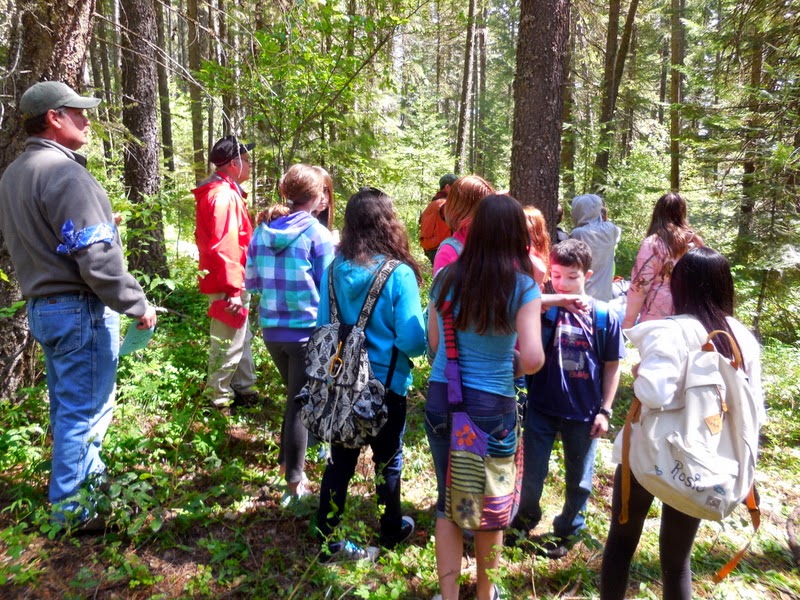
To "celebrate" we volunteered to help out with the 2015 Idaho State Forestry Contest. This is a statewide program designed to teach kids about the wide diversity of trees in Idaho and the best practices for managing this valuable resource.
Not that we love children and look for volunteer opportunities to hang out them. It is well documented that children are all monsters. In addition, human children under 4' 9" all look alike and are almost impossible to tell apart. That aside, we thought it might be fun to check it out.
The gang. With teams from Montana and Washington as well.
Compass and pacing skills
Log scaling
Forest surveying
Tree identification and silviculture
It has been unusually mild since we made it back up to Far North Idaho, with constant sunshine, temperatures in the mid to high 70's and no rain for almost seven weeks now. The asparagus has come and gone, and we've been picking ripe, juicy strawberries for over a week already. But the dry weather has definitely hurt the mushroom season this year. Thankfully, the weather forecast is calling for some clouds and a little rain over the next few days.
Sunday, April 26, 2015
The Markets Can Remain Irrational Longer Than You Can Remain Solvent
For the first 40 years or so of my life, everything I learned about finance revolved around mathematical certainty and fundamental analysis. For more than 100 years of the modern financial system in the U.S., details related to corporate financial reports, GAAP accounting, and valuation actually mattered when making investment decisions.
That all changed in 2008.
In a world of unprecedented government economic intervention, unlimited central banker QE, and the steady erosion of GAAP accounting standards and any pretense of enforcing our existing financial market regulatory laws, every financial asset class has been manipulated to the point where successful investing has required completely different approaches.
Fundamental analysis has become a relic of the past. For a while, cyclical analysis was effective. At times, traditional trend analysis has also been useful. In all cases, you would have had to suspend mathematical logic to make money in the markets over the past seven years.
While the only markets still currently trending higher are the major market indices, the foundation they rest on is more shaky than at any time in my lifetime. The problems that created the last financial crisis (systemic debt and leverage combined with currency debasement) are larger now than they were in 2008. If it even matters anymore, the fundamental underpinnings are also worse than 2008.
The last time there was a divergence this large of stock price vs U.S macroeconomic date was in 2008. How much larger will it get?

Why is the market still rising while forward earnings projections are increasingly negative?

Nothing to see here. Stocks should rise as the U.S. GDP collapses, right? I guess it's the darn weather again.

The Big Boys have been steadily unloading positions into stock market strength. What side of that trade do you want to be on?

And finally the ultimate indicator. When your banana guy starts trading stocks, you know the end of the trend is near.
That all changed in 2008.
In a world of unprecedented government economic intervention, unlimited central banker QE, and the steady erosion of GAAP accounting standards and any pretense of enforcing our existing financial market regulatory laws, every financial asset class has been manipulated to the point where successful investing has required completely different approaches.
Fundamental analysis has become a relic of the past. For a while, cyclical analysis was effective. At times, traditional trend analysis has also been useful. In all cases, you would have had to suspend mathematical logic to make money in the markets over the past seven years.
While the only markets still currently trending higher are the major market indices, the foundation they rest on is more shaky than at any time in my lifetime. The problems that created the last financial crisis (systemic debt and leverage combined with currency debasement) are larger now than they were in 2008. If it even matters anymore, the fundamental underpinnings are also worse than 2008.
The last time there was a divergence this large of stock price vs U.S macroeconomic date was in 2008. How much larger will it get?
Why is the market still rising while forward earnings projections are increasingly negative?
Nothing to see here. Stocks should rise as the U.S. GDP collapses, right? I guess it's the darn weather again.
The Big Boys have been steadily unloading positions into stock market strength. What side of that trade do you want to be on?
And finally the ultimate indicator. When your banana guy starts trading stocks, you know the end of the trend is near.
Who knows, maybe the principals of finance and math have been permanently altered by governments and central banks. Maybe this time things really are different (just like they were in 2000 and 2007). Not that advanced finance degrees and certifications were ever worth anything, but maybe all those hours spent studying and taking exams was wasted. Maybe the irrational levitation of some markets and repression of other markets can continue indefinitely.
If you haven't started lightening up your exposure to stocks, you may want to consider doing so.
Wednesday, April 1, 2015
Three Years on the Road
It's been a busy March. We've been camping and hiking our way through the Chiricahua Mountains in Arizona and the Gila National Forest in New Mexico. We'll probably spend more time in SE Arizona and New Mexico next year.
April 1st marks three years since we've been living and travelling fulltime in our 5th wheel. Why is three years an interesting waypoint? When we started this retirement lifestyle by going to the New Horizons factory for two weeks of training and to take delivery of our rig, we met an old-timer of the road who told us if we made it three years, then most likely we would be doing this a long time. In his experience, it seems that most people give up on living this way within the first three years. They just miss all of their "stuff" too much, grow weary of the occasional challenges that surface, or worse, grow weary of being together so much.
It feels like we left the factory less than a year ago, but a lot has happened over the past three years. We've camped through exotic bug infestations, weld failures on our hydraulic leveling system, a fire on the rig, floods, weather from 12 degrees to 95 degrees, sink holes, and very deep mud. We've had our rig in all of the lower 48 states and Canada, unexpectedly bought a 100 acre Garden of Eden in Far North Idaho for summer boondocking, have enjoyed countless sunsets along with grilled local produce and rare bottles of wine, have sampled food and drink that will remain memorable forever, and have discovered more solitude and wild, wide open spaces than all but a few people will ever know. We've met some interesting people along the way and have made some new friends that will be among our closest for the rest of our lives.
As we start out on our fourth year of fulltime RV travel, we can't see living any other way. Our list of places to go just seems to grow larger. The thrill of finding the next unknown boondocking spot is always there. I guess that old-timer of the road we first met three years ago would say we have a good shot of making this lifestyle work out for us.
April 1st marks three years since we've been living and travelling fulltime in our 5th wheel. Why is three years an interesting waypoint? When we started this retirement lifestyle by going to the New Horizons factory for two weeks of training and to take delivery of our rig, we met an old-timer of the road who told us if we made it three years, then most likely we would be doing this a long time. In his experience, it seems that most people give up on living this way within the first three years. They just miss all of their "stuff" too much, grow weary of the occasional challenges that surface, or worse, grow weary of being together so much.
It feels like we left the factory less than a year ago, but a lot has happened over the past three years. We've camped through exotic bug infestations, weld failures on our hydraulic leveling system, a fire on the rig, floods, weather from 12 degrees to 95 degrees, sink holes, and very deep mud. We've had our rig in all of the lower 48 states and Canada, unexpectedly bought a 100 acre Garden of Eden in Far North Idaho for summer boondocking, have enjoyed countless sunsets along with grilled local produce and rare bottles of wine, have sampled food and drink that will remain memorable forever, and have discovered more solitude and wild, wide open spaces than all but a few people will ever know. We've met some interesting people along the way and have made some new friends that will be among our closest for the rest of our lives.
As we start out on our fourth year of fulltime RV travel, we can't see living any other way. Our list of places to go just seems to grow larger. The thrill of finding the next unknown boondocking spot is always there. I guess that old-timer of the road we first met three years ago would say we have a good shot of making this lifestyle work out for us.
This message has been endorsed by Jake and Karly.
Wednesday, March 4, 2015
This isn't a desert, it's a garden
Of the four major North American deserts, the Sonoran has the most rainfall and, as a result, the most plant diversity. The wettest, most plant-diverse part of the Sonoran desert is in the Organ Pipe Cactus National Monument. It's a long drive to Organ Pipe. Phoenix and Tucson are each about 150 miles away. You have to really want to see a unique part of the desert to make the effort to visit and explore Organ Pipe.
Surprisingly, the landscape and diversity of Organ Pipe isn't evident until you're in the the heart of the place. Driving south through Ajo and Why, all you see is a basic creosote desert with the occasional mesquite, palo verde or sajuaro to break up the scene. We started to worry that we had driven 170 miles from Yuma, AZ just to see the same desert that surrounds Yuma. It's actually 20 miles further South past Why, Az where the desert starts to get interesting.
Like most places, the best parts are not seen from a car. We ended up driving about 80 miles within the park, but the best parts of the park were on the 60 miles of hiking we did in the backcountry. The most impressive scenery was on the side trails where only the smugglers and the Boarder Patrol travel. These areas have been closed for years due to "illegal activity"and have just been reopened.
Surprisingly, the landscape and diversity of Organ Pipe isn't evident until you're in the the heart of the place. Driving south through Ajo and Why, all you see is a basic creosote desert with the occasional mesquite, palo verde or sajuaro to break up the scene. We started to worry that we had driven 170 miles from Yuma, AZ just to see the same desert that surrounds Yuma. It's actually 20 miles further South past Why, Az where the desert starts to get interesting.
Like most places, the best parts are not seen from a car. We ended up driving about 80 miles within the park, but the best parts of the park were on the 60 miles of hiking we did in the backcountry. The most impressive scenery was on the side trails where only the smugglers and the Boarder Patrol travel. These areas have been closed for years due to "illegal activity"and have just been reopened.
A favorite place for travelers over the centuries and for smugglers today is a remote spot called Dripping Springs. The plant diversity just explodes in this wet little ecosystem in the mountains.
A constant flow of water fills the basin in this cave and has saved lives for centuries.
This view looking North from the saddle above the spring is what the smugglers see before they bed down here for the night.
This little steel fence runs for about 40 miles along the mexican border on the southern end of Organ Pipe. It was put in to stop drug smugglers from driving across the border. It's too remote for foot traffic in this area.
And the traditional 30 foot tall anti-personnel fence.
This old bull snake was a surprise to see spread across the trail. It was about 68 degrees, usually too cool for the snakes to come out. He was over five feet long and looked like he may have just had something to eat.
There are abandoned mines all over AZ. Organ Pipe has at least a dozen that we could find. Here's the old store building for the Victoria Mine.
Some impressive thick stone wall and window/door frame construction.
We've been lucky in finding unusual desert inhabitants in the backcountry. Last year we stumbled upon a large desert tortoise and this year we found a grove of rare elephant trees. Most people don't get excited about trees, but these are almost impossible to find outside of a botanical garden. About seven miles into a hike one day we found a grove of ten trees. Not only were there a lot of trees, but they were also the biggest we've ever seen. These trees are in the same family as frankincense and myrrh. When you rub the leaves of an elephant tree it smells like frankincense (kind of a sweet and citrusy fresh pine). FWIW, myrhh tends more towards the black licorice, resiny aroma spectrum.
Just thought we'd include this picture because for some reason the camera made an interesting special effect. It's just a basic, low-cost point and shoot Nikon Coolpix pocket camera.
Tuesday, February 10, 2015
The One Thing RV Boondockers Should Fear
Most people seem to have a romantic vision of their "RV Dream" that includes them parked all alone with the perfect scenic vista of their choice, a drink in one hand, their soul mate's hand in their other hand, and a gorgeous sunset that even Hallmark would envy. Basically, a really nice Cialis commercial.
Once they hit the road, reality sets in. Boondocking involves a lot of unknown variables that makes it just plain inconvenient for most people. So the Cialis commercial morphs into full hook-ups at the closest RV campground with endless potluck dinners and thousands of questions like " How do ya like yer rig?", "Where ya from?", and "How do ya like that new Ford engine?"
Worse than the inconveniences, many people have fears that prevent them from ever really getting away from it all and finding that ideal boondocking spot. There are numerous reasons and not enough space in this post to explain why we have no fear of such things as thieves, rapists, murderers, teenagers, wild animals, poisonous creepy crawlers, loneliness, health issues, cannibals, loss of a Verizon signal, etc.
The only thing that can keep us up at night is.....water.
I'm not talking about the gentle rains that activate the oils on the leaves of creosote bushes and fills the desert with a fragrant, intoxicating aroma. It's the hard downpours that can happen throughout the year in the desert southwest that are the most concerning when it comes to picking a boondocking spot.
We recently found a nice private spot in a desert meadow not far from Organ Pipe Cactus National Monument. We were all alone with great solar exposure, four bars of Verizon, and a nice grassy base rather than the usual sand and rock.
The ground was firm and dry, even though there had been a little bit of rain the week before. When in the desert, I always like to do a thorough walk around of a site to see if I can find any evidence of previous water flow (trying to put that old college hydrology elective to good use). In this case, there was one site that looked like it could dump some water into this meadow during the monsoon season.
After three days in this spot, the weather forecast changed and called for a decent rain event. We decided to hook up and move about a mile away to a typical desert sandy spot.
The rain event turned out to be overblown. Our new sandy site became a little mushy. The big disappointment was when we returned to our old meadow site and found it high and dry. We decided to stay in our new site for a variety of reasons.
A few days later the weather forecast turned again and warned of heavy rains on the Friday and Saturday before the Super Bowl. Our reaction was "yeah sure, we'll see". It started raining early on Thursday afternoon. Nothing hard, but nice and steady. By Friday afternoon, the water outside had started to flow. Where there had been no evidence of previous water flow in our new campsite, a small river formed under the rear of the rig. Pretty soon, our outside mat had floated away.


So water: boondocking friend and foe. There's some food for thought the next time you're camping out in a beautiful remote spot and the cannibals come knocking.
Once they hit the road, reality sets in. Boondocking involves a lot of unknown variables that makes it just plain inconvenient for most people. So the Cialis commercial morphs into full hook-ups at the closest RV campground with endless potluck dinners and thousands of questions like " How do ya like yer rig?", "Where ya from?", and "How do ya like that new Ford engine?"
Worse than the inconveniences, many people have fears that prevent them from ever really getting away from it all and finding that ideal boondocking spot. There are numerous reasons and not enough space in this post to explain why we have no fear of such things as thieves, rapists, murderers, teenagers, wild animals, poisonous creepy crawlers, loneliness, health issues, cannibals, loss of a Verizon signal, etc.
The only thing that can keep us up at night is.....water.
I'm not talking about the gentle rains that activate the oils on the leaves of creosote bushes and fills the desert with a fragrant, intoxicating aroma. It's the hard downpours that can happen throughout the year in the desert southwest that are the most concerning when it comes to picking a boondocking spot.
We recently found a nice private spot in a desert meadow not far from Organ Pipe Cactus National Monument. We were all alone with great solar exposure, four bars of Verizon, and a nice grassy base rather than the usual sand and rock.
The ground was firm and dry, even though there had been a little bit of rain the week before. When in the desert, I always like to do a thorough walk around of a site to see if I can find any evidence of previous water flow (trying to put that old college hydrology elective to good use). In this case, there was one site that looked like it could dump some water into this meadow during the monsoon season.
After three days in this spot, the weather forecast changed and called for a decent rain event. We decided to hook up and move about a mile away to a typical desert sandy spot.
The rain event turned out to be overblown. Our new sandy site became a little mushy. The big disappointment was when we returned to our old meadow site and found it high and dry. We decided to stay in our new site for a variety of reasons.
A few days later the weather forecast turned again and warned of heavy rains on the Friday and Saturday before the Super Bowl. Our reaction was "yeah sure, we'll see". It started raining early on Thursday afternoon. Nothing hard, but nice and steady. By Friday afternoon, the water outside had started to flow. Where there had been no evidence of previous water flow in our new campsite, a small river formed under the rear of the rig. Pretty soon, our outside mat had floated away.
Then the real rain started just as the sun started going down. It was a real rip snorter. Before long, 3/4 of our campsite was a small river as the water flowed over the tops of the access roads on either side of our campsite and came right underneath us.
The hard rain went on for about an hour and a half before slowing to a lighter rain the rest of the night. By Saturday daylight, it was just overcast with intermittent light showers. The small river had been enough to undermine our foundations. The rig had settled a bit and we needed to re- level. Another hour or so of hard rain and we probably would have been in a much deeper hole.
And where there had been no evidence of previous water flow, there was now obvious evidence of the flow through half of the campsite. In retrospect, the sand in this area was a little softer than the hard pack sand in the rest of the site. That softer sand was our hydrological evidence.
Meanwhile, back at our old meadow campsite, the scene was much uglier. Here's a picture of our old site when it was still dry after the rainfall earlier in the week.
This is what it looked like on Saturday afternoon after the heavy rains. This picture was taken from the access road about five feet above the meadow. Based on the debris left from receding water, this new lake peaked at least two feet higher than the level in this picture. We had been camped next to that tree sticking out into the middle of the lake on the left. If we had stayed, we would have had some seriously wet feet.
The water level had been as high as where the dirt color in the picture below changes from brown to white
Even the two access roads to the site were turned into bogs. The water had washed sand into a very large cattle guard, almost filling it in.
On one side, a two foot wide sink hole had formed.
We returned to the scene eight days later. While the waters had receded a bit, it was still almost two feet deep where we had been camped. Between this and the access road mud bogs, we might have been stuck in this spot until March.
So water: boondocking friend and foe. There's some food for thought the next time you're camping out in a beautiful remote spot and the cannibals come knocking.
Thursday, January 22, 2015
Where does your food come from?...Yuma!
If it's green and it's winter, your food probably comes from the agricultural area around Yuma, AZ.
Whether it's trees, wine grapes, row crops, meat or fish, we've always been fascinated by the business and technical skills required to grow and distribute agricultural products. We've taken many university courses on these topics and have worked in the business, but some of the best learning events we've attended over the years have been those sponsored by growers who do it for a living.
Since we were in Yuma, AZ for a while, and Yuma is the agricultural center of the U.S. during the cold winter months, we made sure we were the first people to sign up for two very popular agri-business seminars offered by local farmers here each year.
And you can bank all of this green as well!
In a multiple choice, which of the following agricultural lands would make you the most money? To make it easier, let's define making money as the land that has the highest Cap Rate and ROI per acre.
Wherever you are, support the local farmers.
We spend a lot of time at farmers' markets around the country. That's about as local as most people can get with their food, but while up in Idaho for half the year, we eat foods we grow or forage on our place, eat fish we catch in local streams and lakes, eat lamb and beef that are born and raised on properties that adjoin ours, eat wild game from our land, drink milk from cows and goats raised by neighbors, and so on. It's nice to have a little of that same "ultra-local food from sources you know well" feeling while spending the winter 1,500 miles away from Northern Idaho.
Whether it's trees, wine grapes, row crops, meat or fish, we've always been fascinated by the business and technical skills required to grow and distribute agricultural products. We've taken many university courses on these topics and have worked in the business, but some of the best learning events we've attended over the years have been those sponsored by growers who do it for a living.
Since we were in Yuma, AZ for a while, and Yuma is the agricultural center of the U.S. during the cold winter months, we made sure we were the first people to sign up for two very popular agri-business seminars offered by local farmers here each year.
The University of AZ Ag Extension is extremely active in the Yuma area. They have been instrumental in developing the best seed sources and farming practices that work in Yuma's unique climate and soils.
Celery is a more recent crop added to the Yuma mix. It is incredibly profitable to grow. We like celery, but it's surprising that it's such a cash crop.
Ed Harrison is a fifth generation farmer in the Yuma area. His family farms 7,000 acres. We also learned the origin of Swastika Bridge bridge, which is only about a mile from where his family homesteaded in the early 1920s.
Some of the fine local produce we picked. The yellow cauliflower and purple romaine lettuce were particularly interesting. The same produce we picked will be in grocery stores throughout the Northeast in two days.
Yuma growers custom plant and pick their products. Different packers like different mixes of produce placed in their specific containers. Everything is done according to the packers' orders.
Most of the equipment you see in Yuma are simple harvest aids. They just transfer products from the field to refrigerated trucks. The pictures below show a rare and expensive piece of equipment. This is a custom processing plant on wheels. The produce is custom picked, measured, cleaned, placed in custom packaging and shipped directly from the field to your local store throughout the U.S.
Where the soil is too sandy for row crops, they just grow date palms. Every date palm tree here was propagated from the original trees brought from Morocco back in the early 1920s. We saw the six remaining Mother trees. They were just out in the field by an ag storage building. You'd think they would be cordoned off with a special plaque of some kind.
And you can bank all of this green as well!
In a multiple choice, which of the following agricultural lands would make you the most money? To make it easier, let's define making money as the land that has the highest Cap Rate and ROI per acre.
- Ultra premium vineyard land in the heart on Napa Valley's best appellations?
- America's Garden: The California Central Valley?
- Fertile, deep, black soil in Iowa's best corn producing regions?
- Timber land in Northern Idaho where the six most widely used wood-product trees grow like weeds and disease and fire threats are low?
- Prime citrus growing land in Florida?
- Low elevation desert land around Yuma, AZ?
- Yuma ag land isn't the cheapest to buy or lease (Idaho and Iowa are lower), but the prices matched with the diversity of crop options give it a clear edge over all the others.
- The Yuma growing season and climate isn't the best due to high and low extremes (California, especially the Central Valley, has much more moderate highs and lows), but it is the only land that can be successfully farmed and kept productive for 365 days out of the year.
- Water costs aren't the lowest (Idaho wins that one), but water rights established and refined over 100 years make the cost and availability of irrigation among the most cost effective in the nation.
- Operating costs (equipment, fuel, agricultural inputs, labor) in Yuma are among the lowest in the nation.
- The diversity of crops that can be grown in Yuma is unmatched. In addition, the nature of the farming allows growers to quickly take advantage of fast moving markets. They can change their crop combinations faster.
Wherever you are, support the local farmers.
We spend a lot of time at farmers' markets around the country. That's about as local as most people can get with their food, but while up in Idaho for half the year, we eat foods we grow or forage on our place, eat fish we catch in local streams and lakes, eat lamb and beef that are born and raised on properties that adjoin ours, eat wild game from our land, drink milk from cows and goats raised by neighbors, and so on. It's nice to have a little of that same "ultra-local food from sources you know well" feeling while spending the winter 1,500 miles away from Northern Idaho.
Subscribe to:
Posts (Atom)